Field¶
At a glance…¶
The field node represents an irrigated field: paddocks under crops on a soil that dries by evapotranspiration, fills with rain and irrigation, and orders water upstream to meet each crop's deficit. Each crop's root zone is the FAO-56 daily depletion balance, with the crop's coefficient and a stress coefficient that reduces evapotranspiration as the soil dries. The soil below the roots is kept in layers, so that water left by one crop is there for the next.
A field is supplied by the node above it: a storage outlet, or a supply outlet
(ds_2 to ds_4) of a regulated user or an
unregulated user. What it does not take, and what runs off
the soil, drains down ds_1; the share of the runoff the farm catches leaves on ds_2 instead.
The field has a fallow, which is what is not planted, and up to four crop slots. A crop
is declared once, in a [crop.*] section: what is true of the plant wherever it grows. A slot's
properties are the farmer's decisions for that crop: when to plant, how much, how to irrigate,
when to abandon it. Planting takes area from the fallow; harvest gives it back.
[crop.cotton]
root_depth = 900                    # mm
p = 0.65
kc = Day, Kc,                       # by days since planting
     0,   0.35,
     30,  0.35,
     70,  1.20,
     130, 1.20,
     180, 0.60,
season_len = 180                    # harvested this many days after planting

[crop.bare_soil]
root_depth = 600
kc = 0.4

[node.paddock]
type = field
loc = 30, 40
area = 4.2                          # km2
available_water = 150               # mm of water per m of soil
rain = data.climate_csv.by_name.rain
evap = data.climate_csv.by_name.et0
efficiency = 0.8
fallow = bare_soil
crop_1 = cotton
crop_1_plant = if(sim.month == 10 && sim.day == 15, min(this.area, 0.01 * node.ofs.volume[-1, 0] / 8), 0)
crop_1_order = this.crop_1_area * clamp(this.crop_1_depletion[-1, 0] - 40, 0, 120) / this.efficiency - this.crop_1_orders_en_route[-1, 0]
ds_1 = drain
Crops: [crop.*]¶
A crop is a section in the crop.* namespace, referenced by name from any number of fields. It
is a declaration: numbers and one table, nothing evaluated. The name is lowercase letters,
digits and underscores, starting with a letter.
| Property | Description |
|---|---|
| root_depth (compulsory) | How deep the crop roots [mm]. Its bucket holds available_water × root_depth / 1000 mm of water between full and empty. Example: root_depth = 900 |
| p (optional) | The depletion fraction: the share of the bucket the crop can use before stress begins (FAO-56 Table 22). Default 0.5. Example: p = 0.65 |
| kc (compulsory) | The crop coefficient: a number, or a table of (days since planting, kc) with the FAO-56 curve as its rows, interpolated between rows and held flat beyond the first and last. A text header row is allowed. Example: kc = 0.95 |
| season_len (optional) | Days from planting to harvest. Omitted, the crop is a perennial and is never harvested. Example: season_len = 180 |
Every field has a fallow: a crop with no plants, declared like any other and named by the field's
fallow. It is never irrigated and never planted; it receives area at harvest and abandonment
and gives it up at planting. A field with no crop slots is all fallow, all the time. A fallow's
kc is its bare-soil evaporation factor, and its root_depth is how deep the fallow ground
dries.
Node properties¶
| Property | Description |
|---|---|
| [node.?] (compulsory) | Start of node declaration. This says we are creating a node, and also defines the name of the node. Example: [node.paddock] |
| type (compulsory) | The node type, which is "field" in this case. type = field |
| loc (compulsory) | The location of the node in cartesian coordinates. Example: loc = 30, 40 |
| area (compulsory) | The area of the field [km²]. 1 mm over 1 km² is 1 ML, so 4.2 km² is 420 ha. Readable in expressions as this.area. Example: area = 4.2 |
| available_water (compulsory) | The water the soil holds between full (field capacity) and empty (wilting point), per metre of soil [mm/m] (FAO-56 Table 19: sand 60 to 100, loam 130 to 180, clay 120 to 200). A crop's bucket holds this times its root depth. Example: available_water = 150 |
| fallow (compulsory) | The crop that covers what is not planted: the name of a [crop.*] section. Example: fallow = bare_soil |
| rain (optional) | Rainfall on the field [mm]. Omitted, no rain falls. Example: rain = data.climate_csv.by_name.rain |
| evap (optional) | Reference evapotranspiration [mm], the reference the crops' kc values were derived for (ET₀ for FAO-56 coefficients). Omitted, nothing evaporates. Example: evap = data.climate_csv.by_name.et0 |
| efficiency (optional) | The share of the water supplied that reaches the soil at all. The rest is escape (spray evaporation, wind drift, delivery loss, tailwater the field does not keep) and leaves the model here. Never percolation, which the soil's layers model. Readable as this.efficiency. Default 1. Example: efficiency = 0.8 |
| interception (optional) | Rain reaches the soil only beyond this fraction of the day's evap; the rest wets the canopy and evaporates (intercepted). Default 0.2, FAO-56's interception loss. Write 0 to take rain as given. Example: interception = 0.2 |
| return_fraction (optional) | The share of the field's runoff (excess) that the farm's drains catch. It leaves on ds_2 as return_flow; the rest goes down ds_1 with the bypass. Default 0. See Returning runoff to the farm storage. Example: return_fraction = 0.8 |
| initial_depletion (optional) | How far below full the soil starts, over the whole profile to the deepest roots [mm], every layer alike. Default 0, a full profile top to bottom. Example: initial_depletion = 20 |
| curve_number (optional) | The USDA-NRCS curve number for storm runoff off the paddock surface: the tabled value for average antecedent conditions (CN2), by cover and hydrologic soil group. Each day the curve is chosen between the dry and wet ones by each partition's wetness, so a crop held near full sheds more than the dry fallow beside it. Omitted, rain runs off only when the profile is full. Rain only, never irrigation; daily steps only. See Storm runoff. Example: curve_number = 85 |
| crop_N (optional) | The crop in slot N, for N from 1 to 4: the name of a [crop.*] section. Slots are numbered without gaps. Example: crop_1 = cotton |
| crop_N_plant (compulsory with crop_N) | The area of the crop to plant today [km²]: an expression, read every day the slot is empty, in the order phase (see step 1 of How the node works). Above zero plants the crop on that much land, capped at the fallow's area that day, taking it from the fallow with its water; zero plants nothing. A slot with a crop in the ground is not read; where two slots plant the same day, the lower N goes first. A rule that gives an area every day plants again on the day of a harvest or an abandonment, into the land just returned to the fallow. Negative or not a number stops the run. Example: crop_1_plant = if(sim.month == 10 && sim.day == 15, min(this.area, 0.01 * node.ofs.volume[-1, 0] / 8), 0) |
| crop_N_order (optional) | The irrigation rule for this crop: the order it places upstream each step [ML]. An expression, read only while the crop is in the ground; see The irrigation rule. Omitted, the crop is rain-fed. |
| crop_N_viable_area (optional) | An expression, read every day the crop is in the ground, in the order phase: the area becomes min(area, value) [km²], and what leaves goes back to the fallow with its water. Zero is death. Omitted, the built-in rule applies: a crop whose stress coefficient is 0.05 or below at the start of the day dies, and its area returns to the fallow. Writing any expression replaces that rule entirely. A negative or non-numeric value stops the run. |
| crop_N_kc_multiplier (optional) | An expression, read every day the crop is in the ground, that scales the crop's kc in the evapotranspiration step and nowhere else: et = ks × kc × kc_multiplier × evap. Interception reads evap as it is. For a skip-row planting, a climate adjustment to the tabled curve, or a stress the field does not model. It scales water use, not area: a single-skip cotton crop uses well over two thirds of a solid one, because the canopy spreads into the skip and the skip's soil still evaporates; take the number from the published curves for the configuration. Omitted, 1. Zero is allowed; a negative or non-numeric value stops the run. Example: crop_1_kc_multiplier = if(this.crop_1_days < 60, 0.8, 0.9) |
| ds_1 (optional) | Name of the downstream node on the river: bypass and the river's share of the runoff drain down it. Example: ds_1 = river |
| ds_2 (optional) | Name of the node the caught runoff (return_flow) drains to: a blackhole when it is pumped back to the farm storage through an inflow node, a tailwater dam, or a drain. Example: ds_2 = drain |
Results associated with this node¶
| Result | Description |
|---|---|
| crop_N_area | The area under slot N's crop today [km²]; 0 when nothing is in the ground. Written when planting runs, before any order rule, so this.crop_N_area with no offset is today's area |
| crop_N_days | Days since planting, 0 on the day it is planted; not a number when nothing is in the ground. Written when planting runs, like crop_N_area |
| crop_N_depletion | How far the crop's root zone is below full at the end of the step [mm]: 0 is full, the bucket's capacity is empty. A state, reported at the end of the step like a storage's volume; the irrigation rule reads the previous step's value, this.crop_N_depletion[-1, 0], the soil at the start of today. Not a number when nothing is in the ground |
| crop_N_ks | The crop's stress coefficient this step, 0 to 1, from the depletion at the start of the day. Written the moment it is computed, before the viable-area rule reads it, so this.crop_N_ks with no offset is today's. On the morning a crop is abandoned it is the stress that was read; not a number when nothing stands at the start of the day |
| crop_N_order | The order slot N placed this step [ML] |
| crop_N_order_due | The order placed earlier for slot N that is due to arrive this step [ML] |
| crop_N_orders_en_route | Water on its way to slot N at the end of the step [ML]: ordered, today's order included, and not yet arrived. Zero without travel time from the supply. A state, like crop_N_depletion; the irrigation rule reads this.crop_N_orders_en_route[-1, 0] |
| crop_N_plant | What the planting rule gave today [km²], before the cap at the fallow's area; not a number on a day it was not read, which is every day a crop stands in the slot |
| crop_N_viable_area | What the viable-area rule gave today [km²], or, with no rule written, the area the built-in rule allows: the crop's own area, or 0 the morning it dies. Not a number on a day it was not read: when nothing stands in the slot, and on a harvest day |
| crop_N_kc_multiplier | What the multiplier gave today, 1 when none is written; not a number when nothing stands in the slot |
| crop_N_kc | The crop coefficient used today: the crop's curve at its days since planting, times the multiplier; not a number when nothing stands in the slot |
| fallow_depletion | How far the fallow's root zone is below full at the end of the step [mm] |
| soil_moisture | The water the whole profile holds at the end of the step, to the deepest roots on the field, over the whole field [mm]: every partition's bucket and every layer below it, by area. How much water there is, where the depletions say how much is missing; the profile's capacity is available_water × deepest root depth / 1000 |
| volume | The water held in the node [ML], as volume is on a storage or routing node: the same water as soil_moisture, over the field, soil_moisture × area. The one state whose change is the field's water balance; see Mass balance |
| usflow | Upstream flow: the water that arrives at the field [ML] |
| et | Evapotranspiration over the whole field [mm]: the partitions' ks × kc × evap, each no more than the water its bucket holds, weighted by area |
| et_vol | Evapotranspiration [ML]: et × area |
| rain | The value of the rain expression [mm] |
| rain_vol | Rain on the field [ML]: rain × area |
| intercepted | Rain that did not reach the soil [mm]: min(rain − storm runoff, interception × evap) on each partition, averaged over the field by area |
| evap | The value of the evap expression [mm] |
| excess | All the rain the paddocks shed [ML]: storm runoff off the surface where a curve_number is set, and the overflow of a profile full to the deepest roots. Split between ds_1 and ds_2 by return_fraction |
| supply | The water the field takes from what arrives [ML] |
| escape | The share of supply that does not reach the soil [ML], which leaves the model here |
| bypass | The water that arrives and is not taken [ML], passed down ds_1 whole: the irrigator would have refused it at the pump |
| return_flow | The runoff the farm catches [ML]: return_fraction × excess, on ds_2 |
| dsflow | Downstream flow [ML], both outlets: bypass + excess |
| ds_1 | Flow on link ds_1 [ML]: bypass + excess − return_flow |
| ds_2 | Flow on link ds_2 [ML]: return_flow |
| area | The declared area (a static property) |
| efficiency | The declared efficiency (a static property) |
The crop model, from the top¶
Think of the soil under a crop as a bucket. Each day, rain and irrigation put water in, the crop takes water out, and the field keeps track of how far below full the bucket is. Everything else is deciding when to top it up. Depths are in mm over the cropped area; P is rain and E₀ is reference evapotranspiration.
- Rain that counts. Some rain never reaches the soil: it wets leaves and evaporates.
Effective rain is P_e = max(0, P − 0.2·E₀) (FAO-56); the 0.2 is
interception, and P − P_e isintercepted. - The bucket. The root zone is a column of soil of depth Z_r. Between full (field capacity)
and empty (wilting point) it holds a depth of water TAW = θ_cap · Z_r, where θ_cap is the
soil's water-holding capacity as a fraction (0.1–0.3 is typical). In Kalix θ_cap is the
field's
available_water/ 1000 (150 mm/m is 0.15) and Z_r the crop'sroot_depth. - The state: depletion. D is how far the bucket is below full, in mm. D = 0 is full and
D = TAW is empty. This is the crop's
crop_N_depletion. - What the crop wants. A well-watered crop uses E_c = K_c · E₀, where the crop coefficient
K_c depends on the crop and how far through its growth it is (
kc). A planting that is not a full stand, a single-skip cotton say, uses less: the slot'skc_multiplierscales it. - What it gets when the bucket is low. A crop drinks freely until it has used a fraction
pof the capacity, then less and less: K_s = 1 if D ≤ p·TAW, otherwise (TAW − D) / ((1 − p)·TAW), and E = K_s · E_c. K_s is computed from D at the start of the day (the crop'scrop_N_ks). A crop whose K_s opens the day at 0.05 or below is dead: its area goes back to the fallow and it orders no more water. That is the built-in rule;crop_N_viable_areareplaces it. - The daily balance. With irrigation I reaching the soil:
D_today = D_yesterday − P_e − I + E + drainage.
Part of the water applied never reaches the soil: spray evaporation, wind drift, delivery
loss; in Kalix that share is 1 −
efficiency, and leaves asescape. Whatever would push D below full drains into the soil below the roots, layer by layer, and once that is full runs off, asexcess. - Ordering. The farmer keeps the bucket near a target depletion T. Each day the model works
out what will bring the bucket back to the target when the water arrives, counting what is
already on its way (
orders_en_route), grossed up for the losses in step 6: order = max(0, D − T) / efficiency × area. A refill trigger holds the order back until D reaches a threshold, then fills to T. In Kalix the rule is the crop'scrop_N_orderexpression; see The irrigation rule. - Planting and area. On the plant date the area is set, from a number, a series, or the
water available (
crop_N_plant). The new crop's bucket starts as wet as the ground it is planted into, to its own root depth. Area can later be reduced, never increased, with the surplus going back to the fallow (crop_N_viable_area); at harvest (season_len) all of it goes back. The fallow is itself a crop with no irrigation and a small K_c. - Yield. FAO-33: relative yield = 1 − K_y(1 − ΣE / ΣE_c), the sums running from planting to today. A dead crop yields 0. Later version, if wanted.
That is the whole model: two inputs (P, E₀), one state per crop (D), three soil numbers (Z_r, θ_cap, p), a K_c curve, a loss fraction and a target.
How the node works¶
The steps above, as this version runs them each day, exactly.
The field is partitioned: the fallow, and each crop slot with a crop in the ground. Each
partition works in mm over its own area: 1 mm × 1 km² = 1 ML. The soil is kept in layers whose
boundaries are the field's distinct root depths, fallow included, so every crop's root zone is a
whole number of layers; a layer holds available_water times its thickness. Each partition has
one bucket for its root zone, which the plants and the irrigator work, and one depletion for
each layer below its roots, which only drainage and planting touch. Below the deepest roots on
the field nothing draws, so water that passes is gone.
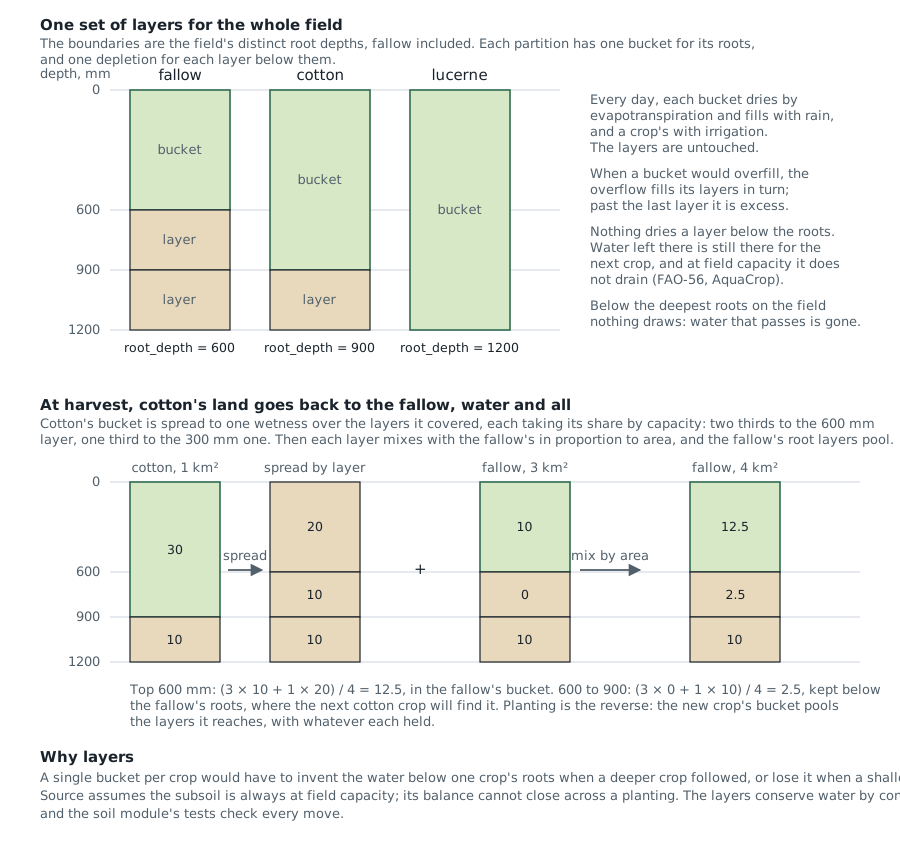
The layers, and what harvest does with them. The 600 to 900 mm layer keeps the deficit cotton left there, below the fallow's roots, until the next deep-rooted crop reaches it.
In this order:
- Planting, so that the day's orders and fluxes use the day's areas. The rules it reads
(
crop_N_plant,crop_N_viable_area) are read in the order phase, likecrop_N_order, before any node's flow phase has run, so they see the previous step's values ([-1, 0]); a field outside every regulated zone has no order phase and reads them at the start of its flow phase instead. Harvest: a crop whose days since planting reach itsseason_lengoes back to the fallow. Abandonment: a crop's area becomesmin(area, crop_N_viable_area), or 0 under the built-in rule when its stress coefficient at the start of the day is 0.05 or below; what leaves goes to the fallow. Planting: a slot with no crop whosecrop_N_plantis above zero takes that much from the fallow, at most what the fallow has. Every move carries area with its water, layer by layer, in proportion to area: the giver's wetness does not change, and the receiver's is the area-weighted mix. Where a root zone shrinks (a deep crop's land going to a shallower fallow) the bucket's water is spread to one wetness over the layers it covered, each taking its share by capacity, and the deeper ones keep it; where it grows, the new bucket pools the layers it reaches, with whatever each held. Nothing is created or lost in a move. - Stress, for each partition, from the depletion
Dof its bucket at the start of the day:ks = clamp((TAW − D) / ((1 − p) × TAW), 0, 1), withTAWthe bucket's capacity andpthe crop's. The crop transpires freely while it has used less thanpof its bucket, and less and less as the soil dries beyond that (FAO-56, equation 84). - Evapotranspiration.
et = ks × kc × kc_multiplier × evap, no more than the water the bucket holds, withkcfrom the crop's curve at its days since planting and the slot'scrop_N_kc_multiplier, 1 unless written. The fallow'skcis its number. - Rain. With a
curve_number, each partition first sheds storm runoff by its own wetness (see Storm runoff). The rest goes on the soil, lessintercepted = min(rain, interception × evap). What would take a bucket below zero drains into the layers below it, filling each in turn; what passes the last layer leaves with the runoff asexcess. - Irrigation. Each crop in the ground takes from what arrives up to its own
order_due, and no more than its bucket has room for after the rain, allowing for the share that escapes:room / efficiency; when there is not enough for every order, lower slots are served first. Water arriving beyond the orders is a forced watering the modeller intended: it is poured over the crops in the ground so as to level their depletion, driest first, each again capped by its room. The fallow is never irrigated. What no crop can take isbypass. Of what is taken,escape = supply × (1 − efficiency)and the rest infiltrates. So irrigation never overfills a root zone, whatever was ordered.
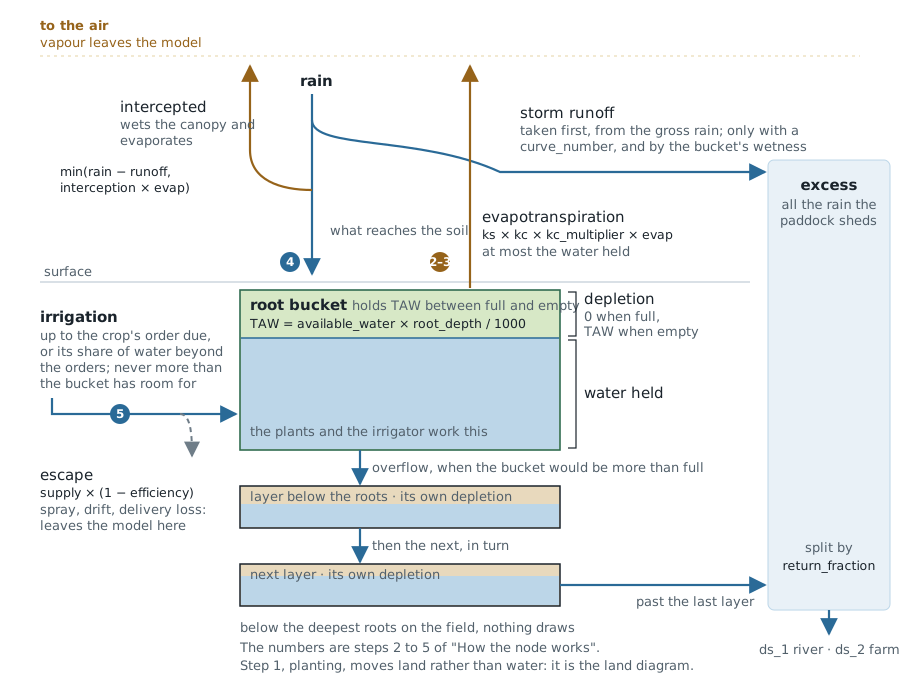
One partition's day. Rain is shed, intercepted or infiltrated; the root bucket is worked by the plants and the irrigator; what it cannot hold fills the layers below, and what passes the last layer is excess.
Rain goes on before irrigation so that a day's rain reduces what a crop takes, rather than
running off a bucket that irrigation has just filled. Effective rainfall is rain − intercepted.
The balance closes every step, to machine precision, and every term is a result:
with usflow = supply + bypass, ds_1 = bypass + excess − return_flow and ds_2 = return_flow.
volume is the water the whole profile holds over the whole field, every partition's
bucket and every layer, so the identity holds through planting, harvest and abandonment, which
move land and its water between partitions but nothing in or out of the field. Nothing leaves
the field except on its links, as evapotranspiration, intercepted rain or escape.
Storm runoff¶
Without a curve number a paddock sheds rain only by saturation excess: when the whole profile,
to the deepest roots, is full. That is how the FAO-56 bucket works, and how NSW's river system
models estimate runoff from cropped areas. The curve number adds the other mechanism, rain the
surface cannot take in a storm, by the USDA-NRCS method that the irrigation industry's own
assessments use. With curve_number set to the tabled CN2 for the cover and hydrologic soil
group, each partition each day:
wetness = 1 − D / TAW                      the root bucket, 0 at wilting point, 1 at field capacity
CN      = CN1 + (CN3 − CN1) × wetness      between the dry and wet curves derived from CN2
S       = 254 × (100 / CN − 1)             mm of retention
runoff  = (rain − 0.2 S)² / (rain + 0.8 S)   when rain > 0.2 S, else 0
CN1 and CN3 are the standard dry and wet curves (CN2 / (2.334 − 0.01334 CN2) and
CN2 / (0.4036 + 0.005964 CN2)), and choosing the day's curve by soil wetness is what APSIM,
HowLeaky and pyfao56 do; the tabled initial abstraction of 0.2 S is kept because the tables are
defined on it. Runoff is taken from the gross rain, and interception from what is left:
intercepted = min(rain − runoff, interception × evap) on each partition. Irrigation never
runs through it:
application losses are efficiency. The method is defined on daily rain totals, and a model
with another step refuses it at load.
A field's runoff is not a catchment's. If the field's area also lies inside a rainfall-runoff node's catchment, both will generate runoff from the same rain.
The irrigation rule¶
The field owns the physics. When to irrigate, and how much, is the farmer's decision, and it is
written per crop in the crop_N_order expression, in ML. The field publishes what the decision
needs:
this.crop_N_depletion[-1, 0], the crop's soil at the start of today [mm];this.crop_N_orders_en_route[-1, 0], what was ordered for it before today and has not arrived before today [ML], which includes what arrives today;this.crop_N_area[km²], today's area, which planting settled before any order rule runs, so it needs no offset; andthis.areaandthis.efficiency.
The depletion and the orders en route are states, reported at the end of each step as a
storage's volume is, so the rule reads the previous step's value; the 0 is what it reads
on the first step, before any value exists. The area is written when planting runs, so a crop
orders on the morning it goes in. The rule is read only while the crop is in the ground; a
slot with nothing planted orders nothing.
The rule the IDE template carries tops the soil up to a target depletion of 40 mm, at most 120 mm in a day, grossed up for escape, less what is already on its way:
crop_1_order = this.crop_1_area * clamp(this.crop_1_depletion[-1, 0] - 40, 0, 120) / this.efficiency - this.crop_1_orders_en_route[-1, 0]
order means what it means everywhere in Kalix, the order placed on the network; the field
places the sum of its crops' orders. Nothing is transformed behind the modeller's back: the
allowance for escape is in the line. Other rules are one line each. A refill trigger, irrigating
to a target once the depletion passes a threshold:
crop_1_order = if(this.crop_1_depletion[-1, 0] >= 60, this.crop_1_area * (this.crop_1_depletion[-1, 0] - 20) / this.efficiency, 0)
Stopping irrigation once the soil is past the point of saving the crop:
crop_1_order = if(this.crop_1_depletion[-1, 0] >= 100, 0, this.crop_1_area * clamp(this.crop_1_depletion[-1, 0] - 40, 0, 120) / this.efficiency - this.crop_1_orders_en_route[-1, 0])
this.crop_N_orders_en_route[-1, 0] matters where there is travel time between the supply and
the field. Without it, a rule that orders the deficit places the same order every day until the
first delivery lands.
Planting, harvest and abandonment¶
crop_N_plant is read every day the slot is empty, and is the area to plant today: zero on
most days, and on the planting day as much as the farmer decides. A date is the common trigger;
the water in hand decides the area:
crop_1 = cotton
crop_1_plant = if(sim.month == 10 && sim.day == 15, min(this.area, 0.01 * (node.ofs.volume[-1, 0] + acc.farm.closing_balance[-1, 0]) / 8), 0)
The 0.01 turns hectares into km²; this line plants a hectare for every 8 ML in the storage and
the account.
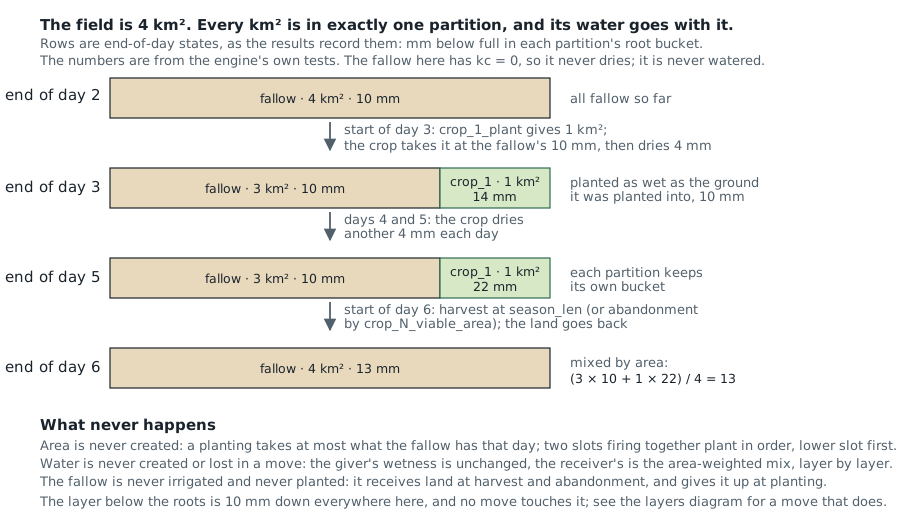
Land moves with its water. The fallow gives up area at planting and takes it back at harvest or
abandonment; every move mixes depletions by area, layer by layer, so nothing is created or lost.
A perennial is planted once and stays (crop_1_plant = if(sim.year == 1990 && sim.month
== 3 && sim.day == 1, this.area, 0), with no season_len on the crop; a rule on a recurring
date would replant it after a death). Several slots may be in the ground at
once: a winter crop in one and a summer crop in another, or the same crop in two slots planted a
month apart.
Harvest is season_len days after planting, the whole area back to the fallow with its water.
Abandonment is crop_N_viable_area: each day the crop keeps at most that area, so it can only
fall. Any value at or above the area keeps the crop whole, so a rule that only ever kills can
return a large number on the days it does not. Written against the crop's own state it is a rule
for abandoning a failing crop, and 0 is death:
A rule that cuts a crop back by a share reads its area, and a viable-area rule is read before
the day's areas are settled, so there the area carries the offset, this.crop_N_area[-1, 0]; in
an order rule, which runs after planting, it does not.
The stress coefficient is the other way about: today's opening ks is written the moment it
is computed, just before the rule reads it, so this.crop_N_ks with no offset is today's, the
same number the built-in rule uses, and this.crop_N_ks[-1, 0] would be a day late.
With no rule written, the field applies its own: a crop whose stress coefficient is 0.05 or below at the start of the day dies. We have included a default, because crops aren't immortal. Because stress reduces evapotranspiration, a dry bucket empties along a flattening curve, and that default is slow to arrive; a written rule can be quicker.
Ordering¶
A field orders like a regulated user: its order travels upstream to the supply, and the field
acts on it after its travel time (see Ordering). The order decides what is released
for the field; what the crops take is decided by the soil, from whatever arrives. So a field
outside any regulated zone, on an unregulated creek say, never places an order (its
crop_N_order, crop_N_order_due and crop_N_orders_en_route results are zero), but
irrigates from what reaches it all the same, and plants at the start of its flow phase.
The links leaving a field are not regulated. A field's outlets carry bypass and runoff away: they are drains, not delivery paths. No order travels up them, and the travel time to the field is no part of the travel time to anything below it.
Returning runoff to the farm storage¶
Runoff has two fates, and the field puts them on two links: the share the farm's drains catch,
return_fraction, leaves on ds_2 as return_flow, and the rest goes down ds_1 with the
bypass. Where the caught runoff is pumped back to the storage that supplies the field, the
storage is defined above the field, and a Kalix model file reads downstream, so no link can carry
water back up to it. The loop is written with a one-step delay, which any loop on a fixed timestep
has anyway: ds_2 ends in a blackhole, and an inflow node above the storage reads the return
flow from the previous step:
[node.returns]
type = inflow
loc = 20, 10
inflow = node.paddock.return_flow[-1, 0]
ds_1 = ofs

[node.ofs]
type = storage
...
ds_1 = paddock

[node.paddock]
type = field
...
return_fraction = 0.8
ds_1 = river        # bypass and the runoff the farm does not catch
ds_2 = drain        # the caught runoff, recreated at `returns` next step

[node.drain]
type = blackhole
The offset is required: without it the run stops with "no value yet", because today's return flow does not exist when the node above the field runs; nothing can build a same-step loop. In the mass balance report the loop appears as a loss at the blackhole and a gain of the same size at the inflow node, one step later; the two pair up by name. The last step's return flow is in transit when the run ends.
Runoff the farm loses for good is ds_2 to a blackhole with no inflow node reading it; runoff
that drains to a tailwater dam or a channel is ds_2 to that node.
Mass balance¶
Only what the field keeps and loses leaves the model at the field: the water the soil holds, in
every bucket and layer, evapotranspiration, intercepted rain, and escape. To see the balance
close, record volume with rain_vol, intercepted, supply, escape, et_vol
and excess: the day-to-day change in the first is the sum of the rest, every day. bypass, excess and return_flow are still
in the model, on ds_1 and ds_2.
References¶
The field is the FAO-56 root-zone water balance, with a layered soil below the roots. Where a choice is not in FAO-56, the reference it follows is given.
- Allen, R.G., Pereira, L.S., Raes, D. and Smith, M. (1998). Crop evapotranspiration: Guidelines for computing crop water requirements. FAO Irrigation and Drainage Paper 56. Chapter 8 is the root-zone depletion balance (equations 82 to 88): total and readily available water, the linear stress coefficient Ks (equation 84), and deep percolation as the overflow of a root zone at field capacity (equation 88). Table 19 gives available water by soil texture, Table 22 root depths and depletion fractions by crop. Chapter 7 is the origin of the interception rule: wettings under about 0.2 × ET₀ evaporate without reaching the root zone.
- Pereira, L.S., Allen, R.G., Paredes, P., López-Urrea, R., Raes, D., Smith, M., Kilic, A. and Salman, M. (2025). Crop evapotranspiration: Guidelines for computing crop water requirements. Second edition, revised 2025. FAO Irrigation and Drainage Paper 56 Rev.1. Updated Kc and Kcb tables, depletion fractions for vegetable, field and tree crops, and the same TAW, RAW, p and Ks framework.
- Thorp, K.R. (2022). pyfao56: FAO-56 evapotranspiration in Python. SoftwareX 19, 101208; and Thorp, K.R. et al. (2024), version 1.3.0, SoftwareX 26, 101724. USDA-ARS's reference implementation. Its depletion to the maximum root depth, with the soil below the roots filled by what the root zone cannot hold and untouched by evapotranspiration, is the same structure as the field's layers; irrigation losses there are likewise taken off the applied water and never counted as percolation.
- Raes, D., Steduto, P., Hsiao, T.C. and Fereres, E. (2026). AquaCrop Reference Manual, version 7.3, Chapter 3. Drainage is zero at or below field capacity (§3.7), which is why the layers keep their water; its convex stress curves (§3.2) are the alternative to FAO-56's linear Ks.
- USDA-NRCS (2004). National Engineering Handbook, Part 630 Hydrology, Chapter 10: Estimation of direct runoff from storm rainfall. The curve number method and its tables. Hawkins, R.H., Jiang, R., Woodward, D.E., Hjelmfelt, A.T. and Van Mullem, J.A. (2002), Runoff curve number method: examination of the initial abstraction ratio, for the case that 0.05 S fits event data better than the tabled 0.2 S.
- APSIM Initiative. SoilWat module, runoff: the daily curve number interpolated between the dry and wet curves by soil wetness, the form the field follows. NSW Department of Planning, Industry and Environment (2019). Assessment of the additional cropped area rainfall runoff occurring due to irrigation: the saturation-excess store of the NSW river models beside the consultants' curve-number estimates for the same farms.
- Bange, M.P., Carberry, P.S., Marshall, J. and Milroy, S.P. (2005). Row configuration as a
tool for managing rain-fed cotton systems: review and simulation analysis. Australian Journal
of Experimental Agriculture 45, 65–77. Water use and yield of solid, single-skip and
double-skip cotton; the place to take a
kc_multiplierfrom, with the industry's WATERpak (Cotton Research and Development Corporation) crop water-use chapters. - eWater. Source Scientific Reference Guide: Irrigator Demand Model. The fallow as a crop with its own depth and coefficient, the planting decision as an authored rule, the effective-rain form of interception, and crop death under sustained stress. Its assumption that the soil below the fallow's roots is at field capacity is the one the field does not make.